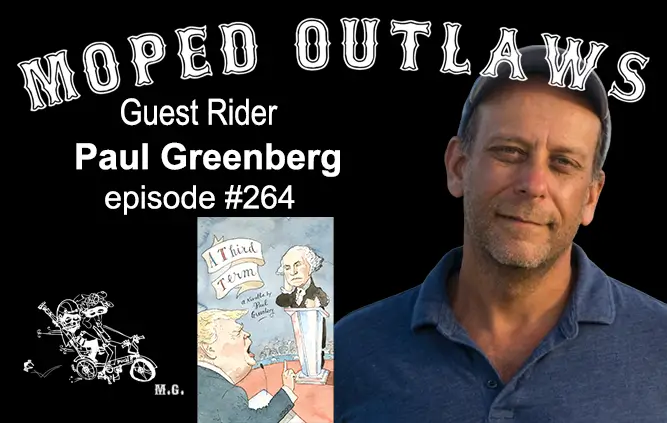
What Happens When We Stop Talking? — Paul Greenberg | Episode #264
What happens when we stop talking to one another?
For Professor Paul Greenberg, that question has been part of a life spent moving between worlds. He grew up with a father who was both a psychiatrist and a film critic, discovered early that writing could be a way of making sense of the world, and eventually found himself in the recently collapsed Soviet Union helping train journalists who were learning how to practice journalism in a new political landscape.
That experience stayed with him. Paul remembers a group of California idealists who believed that if people could simply talk to one another, some of the walls created by the Cold War might begin to come down. Years later, that same belief in conversation seems to echo through much of his work.
Paul is best known as an environmental writer, including his work on the ocean, but his novel A Third Term takes the long road into American political life. The premise is wonderfully strange: George Washington is brought back to the present and asked to run for a third presidential term against a political system that has become increasingly willing to bend its own rules.
What begins with humor gradually becomes something more serious. Washington has to confront the America that grew out of the ideals he helped establish—including the country’s history of slavery and the mistakes that were never fully confronted. The novel asks what happens when one of the country’s founding figures is forced to look directly at what his country became.
Our conversation moves well beyond the book. We talk about the collapse of the Soviet Union, rock and roll and blue jeans, satellite television, propaganda, the Fairness Doctrine, the influence of money on politics, and the strange power of modern political spectacle to keep both supporters and opponents watching.
We also ask whether the answer to an increasingly complicated technological and political world might be found in something much smaller. Paul tells us about buying an acre in the Adirondacks during the pandemic and his attraction to the idea of focusing on what we can actually control—our land, our water, our wood, our fire. But he also recognizes the danger in retreating too far from the larger world. At some point, we still have to engage one another.
That may be the most important thread running through this ride. We don’t have to agree on everything. We don’t even have to like one another’s politics. But perhaps we can begin again by asking better questions, examining actual policies instead of political identities, and remembering that there are still human beings on the other side of the conversation.
Paul also talks about his work in animal studies, his unusual path through Hollywood, his book Goodbye Phone, Hello World, and why he now carries a flip phone. And, because this is Moped Outlaws, we eventually arrive at the question that has no right to be asked in a serious political conversation: Eminem or Foo Fighters?
Sometimes the long road takes us somewhere unexpected.
Guest Links
Main Site: https://www.paulgreenberg.org/
Democratism: https://democratism.org/
Follow Moped Outlaws
Website: https://mopedoutlaws.com/
Facebook: https://www.facebook.com/mopedoutlaws
TikTok: https://www.tiktok.com/@mopedoutlaws
Instagram: https://www.instagram.com/moped.outlaws
YouTube: https://www.youtube.com/@mopedoutlaws
We Support
BLAST: https://blastmovement.org/
Compton Cowboys: https://comptoncowboys.com/
Podcast: Play in new window | Download (Duration: 1:04:19 — 88.3MB) | Embed
Join The Gang Apple Podcasts | Spotify | Amazon Music | Pandora | iHeartRadio | JioSaavn | Podchaser | Podcast Index | Email | TuneIn | RSS | More

