
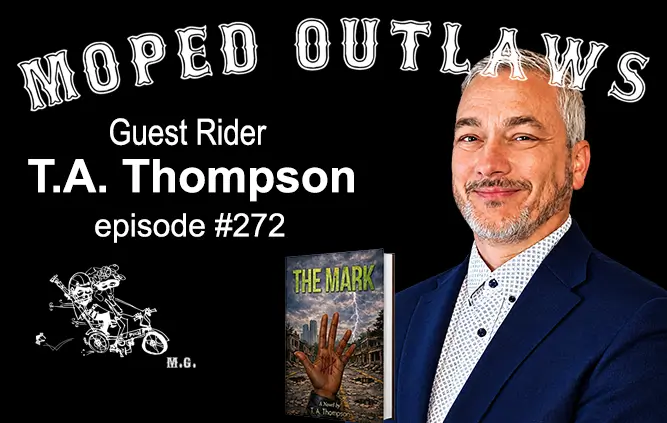
Murder Is Easier Than Divorce – T.A. Thompson | Episode 272
What if you poured years of your life into making something, finally found the courage to release it into the world, and then discovered that getting people to notice was an entirely different adventure?
In Episode #272 of Moped Outlaws, brothers Marc and Greg welcome author T.A. Thompson, whose debut published novel, The Mark, imagines a world where humanity has been genetically altered so that people die by the age of 22. Civilization has collapsed and rebuilt itself into competing societies, each with its own answer to how human beings ought to live.
It’s a brutal, imaginative world. But the more the three talk about it, the more the conversation turns toward the ordinary complications of being alive in this one.
When the World Ends at 22
The idea for The Mark arrived while T.A. was mowing his lawn. A biology presentation he’d given years earlier about telomeres—the protective structures at the ends of chromosomes—had stayed with him. What if something changed the human lifespan so dramatically that people simply dropped dead while they were still young?
That question became a novel about survival, power, inheritance, and the things people will do when tomorrow is never guaranteed.
Greg is struck by the book’s visceral violence and asks how a father thinks about exposing children to violence, both in fiction and in life. T.A. returns to something that becomes a recurring theme throughout the ride: consequences. Actions in a video game may have very little lasting cost. Real life is another matter.
Marc is fascinated by the societies T.A. has invented: a republic in Livingston, a monarchy built around strength in New Sparta, a democratic Huron, and a science-driven Thoth where results can matter more than people. What begins as a discussion of fictional governments becomes a question about how thin the line might be between civilization and survival of the fittest.
And then there’s Alexandra, a mother whose love for her son Duke collides with her growing responsibility to other people. T.A. explains how Charlie, a character he originally imagined as a somewhat goofy addition to the story, gradually became Alexandra’s conscience.
It’s an intriguing turn: the character who makes people laugh may also be the one asking the hardest moral questions.
The Writer Behind the Violence
Greg asks whether writing such a psychologically complicated story revealed anything to T.A. about himself. The answer takes them somewhere personal. T.A. talks about exploring earlier experiences, going to therapy, and making changes to the manuscript after learning more about his own thinking.
He finished the book in 2020 but didn’t publish it until 2026. Some of that delay came from the anxiety of letting other people see what he’d created.
There is also his unapologetic delight in surprising readers. When a beloved character dies and readers complain, T.A. takes it as evidence that they cared. He doesn’t particularly enjoy predictable happy endings.
That leads, naturally enough for these three, from fictional mortality to actual mortality, from personal responsibility to the meaning of being alive, and eventually into whether the scientist who engineered humanity’s collapse might have had a point about what we’re doing to the planet.
Marc asks how long T.A. has been a member of the Illuminati.
Apparently, there’s room for conspiracy-club humor even at the end of civilization.
Where the Conversation Gets Uncomfortable
The imagined lifespan in The Mark also forces an uncomfortable discussion about reproduction, maturity, cultural norms, and the difference between biological development and emotional readiness.
Marc pushes the conversation into territory that produces a moment of genuine silence. Rather than pretending the question wasn’t asked, the three work through the distinction between the demands of a fictional society and the responsibilities and protections that matter in our own.
Later, T.A. describes his blended family: three daughters, three stepsons, and the spectacle of six children emerging from the family car like an endless parade. He also shares what his first marriage taught him about communication and knowing when to pause an argument.
It turns out that an author who likes killing off fictional characters has learned a few things about keeping real relationships alive.
When Creating Is Easier Than Being Seen
One of the most revealing turns comes when T.A. talks about publishing.
He loves writing. Marketing, not so much.
After investing in editing, promotion, and podcast appearances, he has struggled to find readers. He describes paying someone who appeared to be a legitimate book promoter, only to discover that the promised advertising and reviews never materialized.
Greg recognizes the problem from his own experience around films and other creative projects: the promoters can get paid even when the creator sees little return.
Marc and Greg talk about their own desire to keep making something meaningful while still needing the work to support itself. T.A. admits that rejection is difficult, particularly when he’s sending query letters to literary agents and wondering whether the next one will fare any better.
When Greg reflects on how differently we can experience the same thing at different moments in our lives, T.A. appreciates the optimism but admits that staying positive about his writing isn’t always easy.
Marc offers a wonderfully practical response: “You don’t need to be positive. You just need to write the next one.”
The next query letter. The next chapter. Whatever happens to be waiting.
A Few More Miles Down the Road
The ride doesn’t turn into a motivational speech. There are Stephen King books, possible graphic novel adaptations, T.A.’s dislike of AI-generated creative work, a return visit to the Illuminati, and a video game where the author finds himself running and screaming from cannibals and other creatures.
And there’s the joy of the actual work. T.A. describes resisting the prospect of sitting down to write, only to discover an hour and a half later that he’s deep into a chapter and having a wonderful time.
Near the end, he invites listeners to visit his website and request the first three chapters of The Mark. Greg, particularly taken with the prologue, enthusiastically encourages people to buy the book.
Then comes the traditional Moped Outlaws question: Eminem or Foo Fighters?
T.A. doesn’t hesitate. Foo Fighters. Not because he’s an especially big fan, either.
Somehow, after more than an hour of discussing human extinction, moral responsibility, creative rejection, and the struggle to be understood, the ride ends with Dave Grohl catching a little unexpected heat.
Guest Links
T.A. Thompson Website: tathompsonwriter.com
Instagram: @t.a.thompsonwriter
Follow Moped Outlaws
Website: mopedoutlaws.com
Swag: Moped Outlaws Swag
Facebook: Moped Outlaws on Facebook
TikTok: Moped Outlaws on TikTok
Instagram: Moped Outlaws on Instagram
YouTube: Moped Outlaws on YouTube
We Support
BLAST: blastmovement.org
Compton Cowboys: comptoncowboys.com
Podcast: Play in new window | Download (Duration: 1:15:01 — 103.1MB) | Embed
Join The Gang Apple Podcasts | Spotify | Amazon Music | Pandora | iHeartRadio | JioSaavn | Podchaser | Podcast Index | Email | TuneIn | RSS | More
