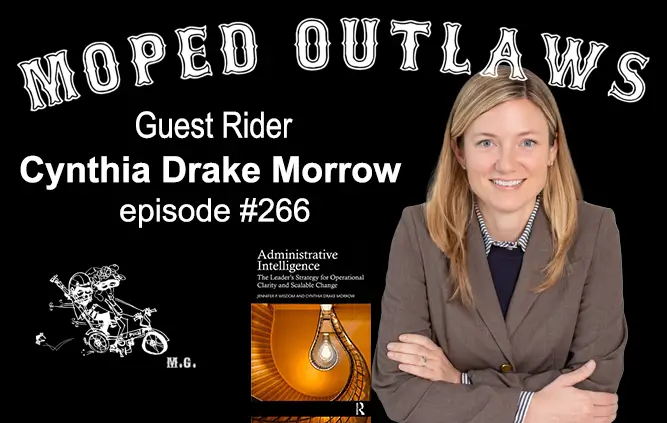
When Systems Shape Us — Cynthia Drake Morrow | Episode 266
What happens when the systems surrounding us begin shaping the way we think, work, lead, and even treat one another?
On Episode 266 of Moped Outlaws, we ride with Cynthia Drake Morrow, assistant professor of public health at Michigan State University, life sciences consultant, researcher, and co-author of Administrative Intelligence with Jennifer Wisdom.
The conversation begins with empathy and emotional intelligence, but quickly moves beneath the surface. Cynthia asks us to look beyond individual personality and consider the organizational forces that can either support or erode empathy, psychological safety, creativity, collaboration, and productivity. Sometimes the problem isn’t that people don’t know how to work together. Sometimes the system itself makes good work unnecessarily difficult.
That idea comes alive in Cynthia’s description of what she calls “portal land”—the maze of systems, platforms, permissions, billing structures, incentives, and administrative workarounds that can grow inside organizations. What may look like a technology problem or an individual performance problem can actually be a symptom of deeper structural forces.
We talk about the relationship between psychological safety and accountability, why a little human connection at work can matter when things go wrong, and how organizational change makers can identify their own scope of influence even when they don’t have formal authority.
The conversation also travels into economic forces, generational differences, mergers and acquisitions, organizational values, consumer transparency, and the difficult question of how leaders can create meaningful change when the incentives around them point in another direction.
And then the road turns toward artificial intelligence.
Cynthia describes one of her concerns about AI in education: when writing becomes automated, writing and evidence verification can become separated. The work doesn’t disappear, she argues; it transforms into checking sources, testing logic, and making sure that what has been produced actually stands on evidence. That leads naturally into one of the conversation’s larger questions: where do intuition and logic meet when we’re trying to understand something we don’t yet know?
Throughout the ride, Cynthia returns to a deceptively simple idea: people are shaped by the systems around them. If we want different outcomes, changing individual behavior may not be enough. Sometimes we have to examine the infrastructure itself.
Because the road to better work may not be about asking people to simply try harder. It may be about building systems in which good work, curiosity, empathy, creativity, and human connection have room to exist.
Guest Links
Book: https://bit.ly/cynthia-morrow
LinkedIn: https://www.linkedin.com/in/cynthia-morrow/
Main Site: https://www.evinarrative.com/
Follow Moped Outlaws
Website: https://mopedoutlaws.com/
Facebook: https://www.facebook.com/mopedoutlaws
TikTok: https://www.tiktok.com/@mopedoutlaws
Instagram: https://www.instagram.com/moped.outlaws
YouTube: https://www.youtube.com/@mopedoutlaws
We Support
BLAST: https://blastmovement.org/
Compton Cowboys: https://comptoncowboys.com/
Podcast: Play in new window | Download (Duration: 1:03:04 — 86.6MB) | Embed
Join The Gang Apple Podcasts | Spotify | Amazon Music | Pandora | iHeartRadio | JioSaavn | Podchaser | Podcast Index | Email | TuneIn | RSS | More
